.webp)

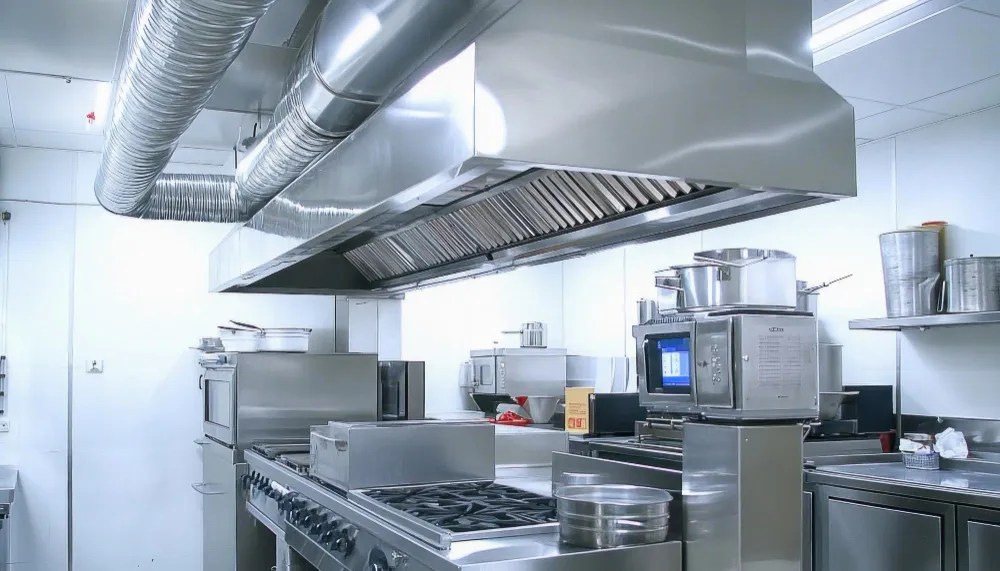
Why is my commercial vent hood not pulling air?
A commercial vent hood that stops pulling air almost always has one of three causes: a grease-clogged filter restricting airflow, a failed or tripped exhaust fan motor, or a ductwork blockage from accumulated grease.
In most restaurant kitchens in Charlotte and Huntersville, the first thing to check is the hood filters — heavily loaded filters reduce airflow dramatically and are often overlooked between scheduled cleanings. If the filters are clean and the hood still isn't pulling, a technician needs to inspect the fan motor or motor starter.
What are the most common signs of a commercial hood problem?
Commercial kitchen ventilation problems rarely appear all at once. The most common warning signs we see on service calls across Charlotte, Huntersville, and Mooresville are:
- Smoke and haze staying in the kitchen — the clearest sign the hood is not capturing combustion byproducts effectively
- Higher kitchen temperatures than usual — often caused by a failed makeup air unit that is no longer replacing exhausted air with conditioned supply air
- Grease dripping from the hood — a sign filters are overloaded and grease is bypassing into the ductwork
- Rattling or grinding noise from the rooftop fan — loose fan components or a bearing beginning to fail
- Hood turns on but airflow is weak — partial motor failure, belt slip, or heavy duct restriction
- Hood does not turn on at all — tripped breaker, failed motor starter, or tripped service switch at the rooftop unit
Can a restaurant be open with the vent hood not working?
No — not legally and not safely. Commercial kitchen ventilation is required by health codes, fire codes (NFPA 96), and local building ordinances. A non-functioning exhaust hood creates several immediate risks: grease-laden air accumulates in the duct system and increases fire risk significantly, combustion byproducts from gas equipment build up in the kitchen and create an unsafe working environment, and health inspectors can and do issue closure orders for ventilation failures.
Most jurisdictions require the exhaust hood to be operational any time cooking equipment is in use. If the hood fails during service, the correct response is to stop cooking on equipment that generates smoke or grease-laden vapors and call for emergency repair.
What causes a commercial exhaust fan motor to fail?
The rooftop upblast exhaust fan is the component that drives the entire ventilation system. When it fails, the hood has no suction regardless of how clean the filters are. Fan motor failures in Charlotte-area restaurants typically fall into three categories:
- Grease contamination — grease migrates up the duct and reaches the fan housing, causing bearing wear and eventual motor seizure. This is the most common cause we see on calls where regular hood cleaning has been skipped or delayed.
- Motor starter failure — the starter is located inside the access panel on the hood itself. It has a trip button and reset button. If the starter trips repeatedly, the motor itself is likely failing and drawing excess current.
- Phase loss — three-phase motors used in larger commercial ventilation systems can shut down if one phase of the electrical supply is lost. This requires the power company and an electrician to diagnose but presents as sudden complete fan failure.
How do technicians diagnose a commercial vent hood that is not working?
A proper commercial hood service call in a Charlotte-area restaurant follows a specific sequence. Our technicians check the following in order before any parts are ordered:
- Filters and grease cup — confirm whether restricted airflow is the primary issue before anything electrical is touched
- Breaker and service switch — the rooftop service switch is frequently found in the off position after a previous repair or cleaning visit
- Motor starter in the hood access panel — trip and reset buttons confirm whether the starter has tripped and whether it holds or trips again under load
- Fan motor resistance and current draw — electrical testing confirms whether the motor windings are intact or whether the motor has failed
- Duct inspection for blockage — heavy grease accumulation in the duct reduces airflow even when the fan is running normally
How long does commercial vent hood repair take in Charlotte NC?
Most commercial hood service calls are completed the same day. Fan motor replacements, motor starter replacements, and filter-related airflow issues are all resolved in a single visit in the majority of cases. Parts for standard commercial upblast fans are stocked for same-day repair on the most common makes. Duct cleaning, if required, is scheduled separately as it involves specialized equipment and takes longer than a standard repair visit.
When should I call for commercial kitchen hood repair in Charlotte NC?
Call immediately if the hood has stopped pulling air, if you can smell smoke in the dining area, if the rooftop fan is making unusual noise, or if the hood will not turn on. Do not continue cooking operations under a non-functioning hood — the grease accumulation risk and health code exposure are not worth the delay.
Our technicians serve restaurants, ghost kitchens, food service facilities, and commercial kitchens across Charlotte, Huntersville, Cornelius, Mooresville, and surrounding areas with same-day emergency response available.
Featured Articles
.svg)